Blog
What AI Won’t Fix in Project Management – and Why Strong Processes Still Matter
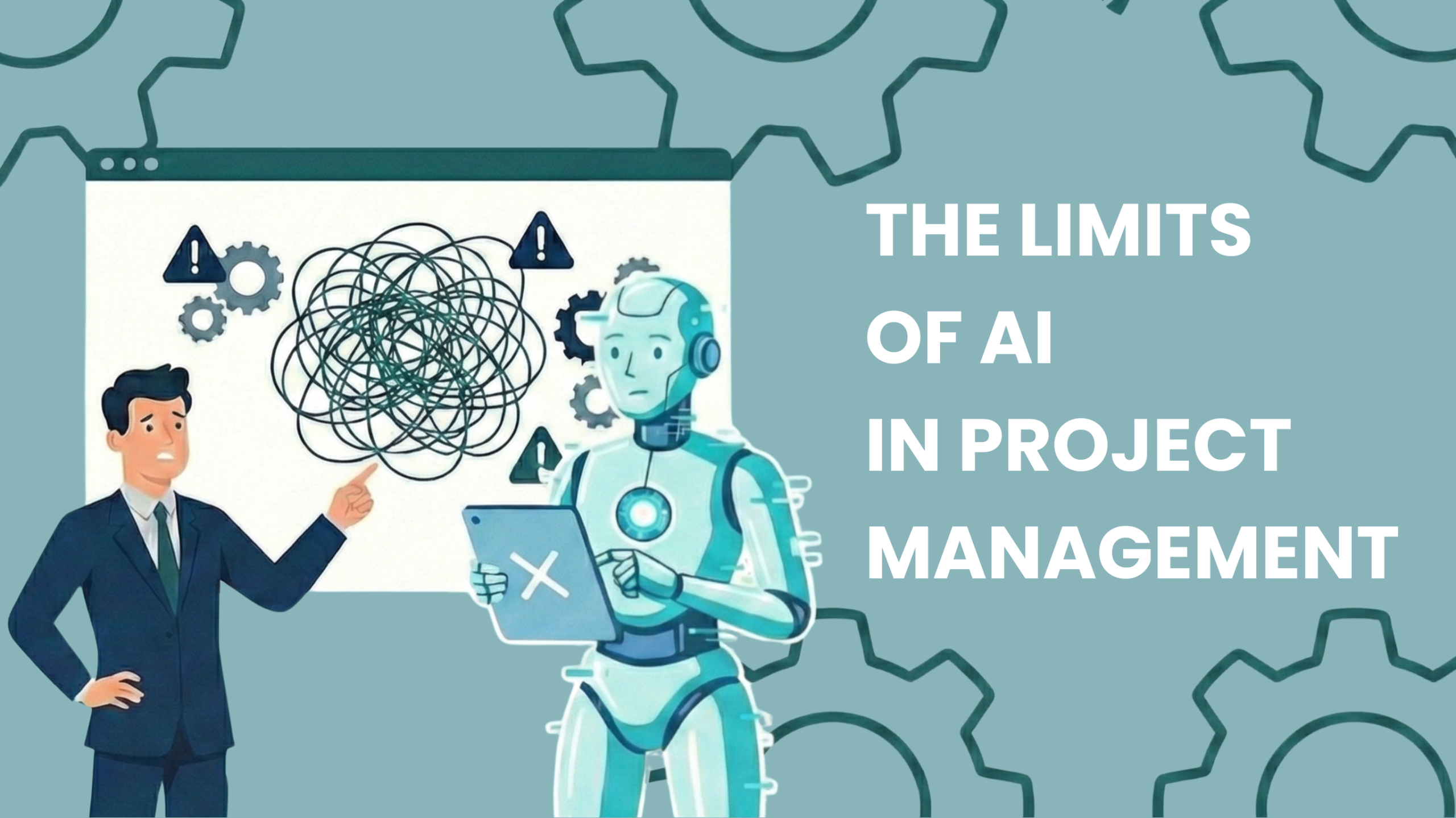
AI in project management has become a standard claim across modern software tools. Predictive schedules, automated risk detection, and smarter portfolio decisions are now routinely presented as AI-driven capabilities.
At first glance, this sounds like a breakthrough. Projects are complex, data-heavy, and full of uncertainty. If any domain could benefit from intelligent assistance, surely this is one of them. Yet as AI claims multiply, some uncomfortable questions rarely enter the conversation.
This article takes a grounded view of AI in project management. It examines what AI cannot fix, why certain promises break down in real project environments, and why strong processes still matter – even as AI capabilities continue to evolve.
1. What Does “AI-Powered” Mean in a Project Management Context?
Before evaluating what AI can improve, it’s worth clarifying what is actually being claimed.
“AI-powered” is now used to describe a wide range of capabilities in project management software, often without clear distinction between them.
In complex project and portfolio environments, which problems can AI realistically help with, and which still require human judgment and structure?
This distinction matters because expectations are rising quickly. In enterprise project management and PPM, decisions affect budgets, timelines, compliance, and accountability. When AI is positioned as a shortcut around governance or discipline, it often creates more confusion than value.
Before asking what AI can do for project management, it’s worth asking a simpler question: what does “AI-powered” actually mean in practice?
The answers are less glamorous than the headlines – and far more important.

2. AI in Project Management Is Not One Thing
One reason expectations around AI in project management have become inflated is that the term itself has lost precision.
Today, “AI-powered” can refer to very different capabilities, often grouped under the same label despite having little in common in how they function or the value they provide. In some tools, AI is limited to assisting with text or navigation. In others, it supports analysis across large datasets. Much more rarely, it interacts with core project logic.
These differences matter, because they shape what AI can realistically influence.
Common levels of AI use in project management tools
- Interface-level AI: Used to search, summarize, or interact with data more naturally. The underlying project logic remains unchanged.
- Analytical AI: Applied to detect patterns, correlations, or anomalies across projects, resources, or risks, without making decisions.
- Decision-support AI: Used to simulate scenarios or highlight options within predefined rules and constraints.
- Execution-level AI: Capable of directly changing schedules, resources, or plans. This is rare in serious PM and PPM environments due to governance and control requirements.
All of these approaches can legitimately be described as AI. But they do not imply the same level of system intelligence, autonomy, or responsibility.
When these distinctions are unclear, AI is often assumed to understand project context or guide decisions in ways it was never designed to do. In practice, most AI implementations operate at the edges of project management systems rather than at their core.
This does not make them ineffective. But it does explain why early excitement is frequently followed by confusion when AI is perceived as a decision-maker rather than an analytical assistant.
Understanding where AI operates – and where it does not – is essential before evaluating what it can realistically improve in project management.
3. Why Project Management Is a Hard Problem for AI
At first glance, AI in project management appears well suited to automation. Projects generate structured data, follow timelines, and depend on forecasting – all areas where AI performs well in other domains.
The difficulty lies in what that data represents.

Projects are decision systems, not data sets
Projects are not static collections of tasks and dates. They are decision systems shaped by trade-offs, assumptions, and constraints that evolve over time. Schedules encode priorities. Risks reflect judgment. Plans capture intent that is often implicit rather than formally defined.
As projects scale into enterprise and portfolio environments, this complexity increases. Multiple initiatives compete for shared resources, and priorities shift as strategy changes.

Context changes faster than models
AI performs best in stable systems. Project environments are rarely stable.
Regulatory requirements, contractual commitments, and financial constraints frequently change during execution. What was acceptable early in a project may no longer apply later. While AI can detect patterns or deviations in historical data, it cannot inherently understand why certain changes are acceptable and others are not.
That context lives outside the data – in governance models, escalation paths, and human accountability.
 Where AI fits – and where it doesn’t
AI can support analysis, highlight deviations, and improve visibility. What it cannot do reliably is replace the decision structures that hold complex project environments together.
This distinction matters when evaluating claims around predictive insight or automated optimisation. Without strong decision frameworks, AI in project management quickly reaches its limits.

4. Why “AI Understanding” Project Health Is a Myth
Project health is one of the most common promises attached to AI in project management. Tools claim to detect risk early, explain why projects are drifting, and highlight where intervention is needed.
The appeal is obvious. The challenge is that project health is not a fixed concept.
Project health depends on context
Project health is not an objective or consistent measure. A delayed milestone, cost variance, or resource overload does not mean the same thing in every organization. What triggers escalation in one environment may be an accepted trade-off in another.
For AI to assess project health meaningfully, those thresholds and tolerances must already be defined. Without them, AI can only flag indicators such as delays or utilisation spikes without understanding whether they require action.
Detection is not interpretation
AI can identify deviations. It cannot decide whether those deviations matter.
When a system labels a project “high risk,” it assumes shared definitions of urgency and impact that often exist outside the data itself. Those judgments come from governance rules and management intent, not algorithms.
This gap becomes more visible at portfolio level, where trade-offs between projects are deliberate and constantly changing.
AI can support visibility. It cannot replace judgment.

5. Why AI Cannot Prioritize Work the Way Humans Expect
Prioritization sits at the core of project management. Teams constantly decide what to do first, what can wait, and what trade-offs are acceptable.
AI can support this process, but it cannot own it.
Prioritization reflects judgment, not ranking
In real project environments, priority is rarely determined by a single factor. A task may be late but strategically critical. A risk may look severe but remain acceptable. A dependency may block progress in theory but be tolerated to protect a larger objective.
These decisions reflect intent, risk appetite, and timing – not just data.
AI can rank tasks based on rules or patterns, but those rules must already exist. When priorities change, it has no inherent way to know why they changed or whether the shift is temporary or strategic.
Signals do not equal decisions
AI can surface useful signals:
- Capacity conflicts
- Deadline collisions
- Risk concentration
What it cannot do is decide which issue deserves attention now.
That choice often involves incomplete information, competing objectives, and consequences that extend beyond a single project. Responsibility for those trade-offs must remain human.
AI can inform prioritization. What it cannot do is assume responsibility for those choices.

6. The Limits of AI in Data Integrity, Control, Roles, and Accountability
AI in project management works best when it analyzes data. The moment it moves from analysis to action, the limits become clear.
In enterprise project environments, project data is not neutral. Every task, date, budget, and resource assignment is tied to roles, permissions, and accountability. Different users see different information, propose different changes, and approve different decisions. These boundaries are intentional and essential. This creates a fundamental constraint for AI.
Project systems are designed to reflect this structure. Not all changes carry the same weight, and not all decisions belong at the same level. Adjusting progress, revising plans, reallocating budgets, or reshaping priorities each imply different degrees of impact and accountability.
For AI to operate meaningfully in this environment, it would need to navigate these distinctions – understanding not just the data itself, but the decision context around it. That includes knowing which changes can be suggested freely, which require review, and which demand explicit approval.
This is why autonomous change quickly becomes problematic. Automatic adjustments are not neutral optimizations; they shift responsibility. In controlled project environments, accountability must remain traceable, and decisions must remain attributable.
AI can propose alternatives, highlight conflicts, or simulate outcomes. It cannot assume responsibility across decision boundaries.
In project management, control is not a limitation of AI. It is what makes its use acceptable at all.

7. Where AI Can Realistically Add Value in Project Management
When expectations are realistic, AI in project management can be genuinely useful – not as a decision-maker, but as a support layer.
The most reliable applications of AI work with existing structures. They reduce effort, improve visibility, and help teams interpret information faster, without changing how decisions are governed.
In practice, AI adds value in a few focused areas:
- Pattern analysis across portfolios
AI can scan large volumes of project data to surface recurring delay patterns, common risk combinations, or systemic bottlenecks that are hard to detect manually. - Assisted interpretation of structured data
When project information is consistent, AI can summarize status, highlight changes, and answer targeted questions more efficiently. - Support for text-heavy project artifacts
AI can synthesize risks, issues, and lessons learned, making qualitative information easier to review and compare.
What these use cases share is restraint. AI supports analysis and access to information. It does not set priorities, approve changes, or override governance rules.
The value of AI in project management is therefore incremental. It improves how teams interact with data, not how responsibility or accountability is assigned.

8. How to Interpret AI Claims in Project Management Software
As AI becomes standard in project management software, the key question is no longer whether a tool “uses AI,” but how and where it applies it.
Many AI claims sound similar but refer to very different capabilities. Interpreting them requires focusing less on labels and more on scope.
Where AI actually operates
In many tools, AI operates at the interface level – helping users search, summarize, or navigate information. In others, it supports analysis by detecting patterns or anomalies. Far less commonly does AI interact with core planning logic, governance rules, or execution controls.
Understanding this distinction is critical when evaluating claims.
How close AI gets to execution
The closer AI moves toward execution, the more constraints apply. Real project environments require approvals, role-based access, auditability, and traceability. Any claim that implies autonomous correction or self-adjusting plans should be examined carefully.
In most enterprise PM and PPM contexts, AI remains advisory rather than authoritative.
What data AI depends on to work
AI outputs are only as reliable as the structure behind them. If prioritization rules, risk thresholds, or escalation criteria are unclear or inconsistent, AI has no stable basis for interpretation.
In those cases, outputs may appear intelligent but remain largely descriptive.
Where responsibility stays
AI can surface issues, suggest alternatives, or simulate outcomes. Responsibility for decisions must remain explicit. When AI claims blur the boundary between assistance and decision-making, they tend to overstate capability.
Interpreting AI claims does not require deep technical knowledge – only clarity about role, scope, and control.

Key takeaways
- AI in project management is not one thing. Claims vary widely, from interface assistance to analytical support, and rarely imply decision authority.
- Project environments are decision systems, not data problems. Context, trade-offs, and accountability limit what AI can infer or automate.
- AI can detect signals, but interpretation remains human. Project health, prioritisation, and urgency depend on governance and intent, not metrics alone.
- Roles, permissions, and accountability constrain AI by design. These boundaries are intentional and essential in serious PM and PPM environments.
- The most reliable AI value is supportive, not autonomous. AI works best when it enhances visibility and analysis without bypassing control.
9. Conclusion: What Still Matters More Than AI in Project Management
As AI becomes more visible in project management software, it is often treated as a differentiator in itself. In practice, its impact depends far more on the environment it operates in.
Across complex project and portfolio settings, the same foundations continue to matter: clear governance, defined roles and responsibilities, disciplined data, and explicit decision ownership. AI can enhance visibility, surface patterns, and reduce friction, but it does not remove the need for judgment, accountability, or control.
Where structures are clear, AI in project management can strengthen existing decision frameworks. Where they are weak or inconsistent, AI tends to reflect those weaknesses rather than correct them.
The real value of AI lies in how it supports people, not in replacing the systems that make projects manageable. As capabilities evolve, the organizations that benefit most will be those that treat AI as an extension of strong processes – not a shortcut around them.












 Project Management


 Portfolio Management

 Task Management


 Gantt Chart


 Kanban Board


 Scheduler


 Resource Management

 Time Tracking


 Expense Tracking


 Content Management


 Collaboration


 Reporting


 Portfolio Management


 Project Management


 Resource Management


 Time & Expense Tracking


 Gantt Chart Planning
  Cost & Budget Management


 Demand Management


 Stage and Gate Review Support


 Document Management


 Team Collaboration


 Risk & Change Management


 Dashboards & Reports


 Workflow Management


 Integrations
 Customization
 Integrations
 Security
 Hosting
 Configuration