Contents
- What is the Stage-Gate process?
- The stages and gates of the Stage-Gate process at a glance
- How gate reviews work
- Origins of the Stage-Gate process
- Benefits of the Stage-Gate process
- Where the Stage-Gate process is used
- Roles and responsibilities in the Stage-Gate process
- Stage-Gate and other project management methodologies
- How to implement the Stage-Gate process
- Best practices and common mistakes
- How to measure Stage-Gate success
- Stage-Gate across a project portfolio
- How software supports the Stage-Gate process
- Stage-Gate process checklist
- Frequently asked questions
What is the Stage-Gate process?
The Stage-Gate process (often called a phase-gate process or stage-gate model) is a project governance framework that divides a project into a series of stages separated by decision points called gates. At each gate, a group of senior decision-makers, the gatekeepers, reviews what the team has delivered and decides whether the project deserves further investment.
The idea is simple: invest in steps. Early stages are cheap and fast and answer the biggest questions (is there a market, is it technically feasible, does it fit our strategy?). Later stages are expensive and only happen for projects that have earned the right to continue. This reduces the risk of spending heavily on products that will fail.
Stage-Gate was designed for new product development, which is why searches for an “NPD stage gate process” lead to the same model. Today it is also used for capital projects, technology implementations and other investments where an organization wants clear decision points before committing more resources. See also Stage-Gate process in our glossary.
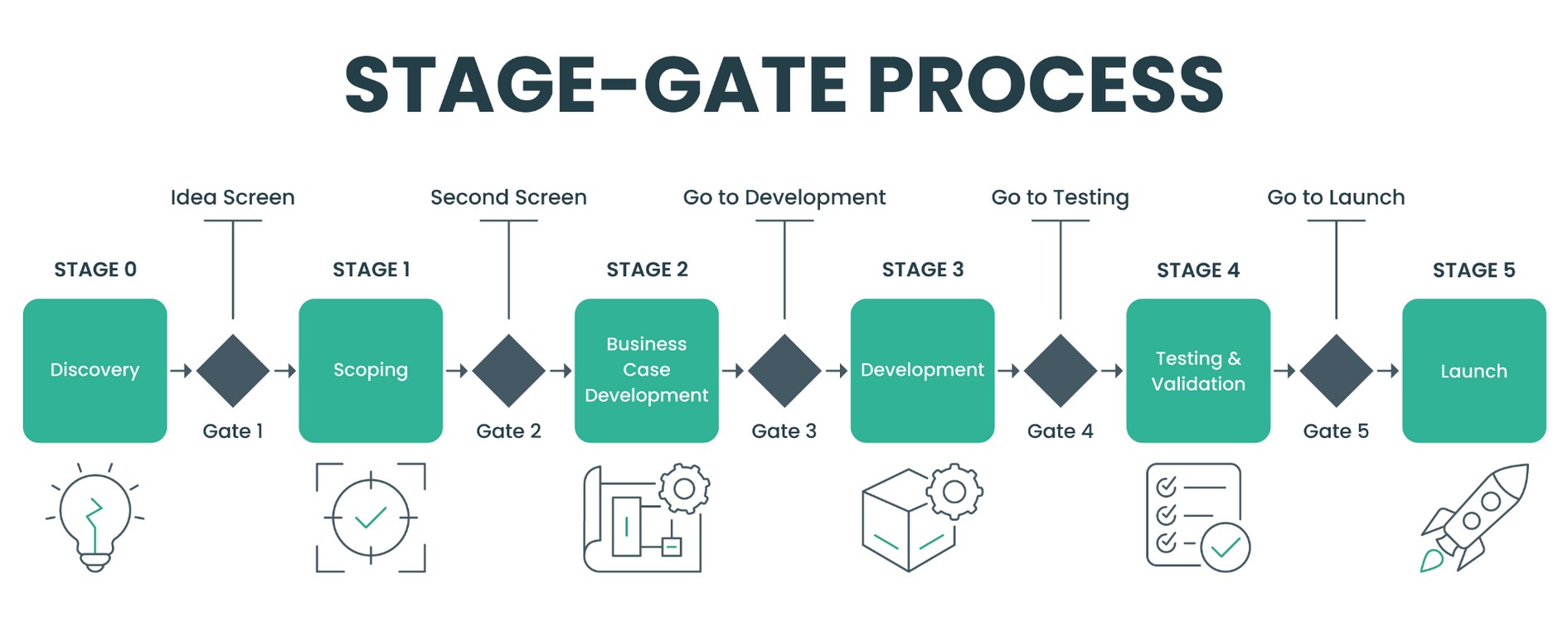
The stages and gates of the Stage-Gate process at a glance
| Step | Purpose | Typical deliverables | Decision |
|---|---|---|---|
| Stage 0: Discovery | Generate and capture ideas | Idea description, initial strategic fit | Gate 1: Idea screen |
| Stage 1: Scoping | Quick, low-cost assessment of the opportunity | Preliminary market and technical assessment | Gate 2: Second screen |
| Stage 2: Business case | Build the case for investment | Market research, product definition, financial analysis, project plan | Gate 3: Go to development |
| Stage 3: Development | Design and build the product or solution | Prototype or working product, test plans, launch and operations plans | Gate 4: Go to testing |
| Stage 4: Testing and validation | Prove the product, process and market acceptance | Test results, customer trials, regulatory checks, updated financials | Gate 5: Go to launch |
| Stage 5: Launch | Introduce the product to the market | Launch execution, production ramp-up, post-launch review | Post-launch review |
The number of stages is not fixed. Many organizations use fewer stages for smaller, lower-risk projects (for example, combining scoping and business case) and keep the full model for large, risky ones.
Stage 0: Discovery
Ideas come from customers, sales, R&D, technology scouting, competitors and strategy reviews. The goal is to capture them in a consistent format so that they can be compared. Gate 1 (idea screen) is a quick check: does the idea fit our strategy, and is it worth spending a little time on?
Stage 1: Scoping
A small team does a fast, inexpensive assessment: desk research on the market, a first look at technical feasibility, obvious risks and a rough idea of costs and benefits. Gate 2 (second screen) decides whether the opportunity justifies building a full business case.
Stage 2: Business case
This is the most important homework stage. The team defines the product and target market, confirms customer needs, assesses technical and operational feasibility, and builds a financial case and a project plan for the rest of the project. Gate 3 (go to development) is the major investment decision: after this gate, spending rises sharply.
Stage 3: Development
The product or solution is designed and built, often in iterations with customer feedback. The team also prepares the test plan, manufacturing or operations plan and the launch plan. Gate 4 (go to testing) checks that development is complete and that the business case still holds.
Stage 4: Testing and validation
The product, the production process and market acceptance are validated: lab and field tests, customer trials, pilot production, regulatory and quality checks. Gate 5 (go to launch) is the final decision to commercialize, based on test results and updated financials.
Stage 5: Launch
The launch plan is executed: production ramp-up, marketing, sales enablement and support. A post-launch review, typically several months later, compares results with the business case and captures lessons for future projects. For more on this stage, see streamlining product launches with Stage-Gate.
How gate reviews work
Gates are what make Stage-Gate different from a simple phase plan. A good gate has three elements:
- Deliverables: what the team must bring to the gate, defined in advance (for example, a business case, test results or a launch plan).
- Criteria: what the gatekeepers judge the project on. Many organizations use must-meet criteria (knock-out questions such as strategic fit or legal compliance) and should-meet criteria (scored factors such as market attractiveness, technical feasibility, competitive advantage and financial return).
- Outputs: a clear decision and, if the project continues, an approved plan and resources for the next stage.
| Gate decision | Meaning |
|---|---|
| Go | The project continues; resources for the next stage are approved |
| Kill | The project stops; resources are released to other projects |
| Hold | The project is sound but not a priority now; it is parked |
| Recycle | The project must rework the current stage before it can pass |
The gatekeepers are usually senior managers from the functions that own the resources: R&D, marketing, operations, finance and sometimes quality or regulatory. They need the authority to commit those resources, and they should apply the same criteria to every project. Our Stage-Gate review checklist helps project teams prepare decision-ready gate reviews. See also gate review in our glossary.
Origins of the Stage-Gate process
The Stage-Gate process was developed by Dr. Robert G. Cooper in the 1980s. Cooper studied why some new products succeeded and others failed, and found that successful companies did more up-front homework, made sharper go/kill decisions and organized product development as a disciplined, cross-functional process. He described the model in a 1990 Business Horizons article on “stage-gate systems”, and it spread quickly through consumer goods, chemicals and manufacturing before reaching technology, pharma, automotive and other sectors.
The model has evolved since. Later versions put more emphasis on scaling the process to project size, on flexible and overlapping stages, and on combining Stage-Gate with Agile methods during development (see Stage-Gate and other methodologies below).
Benefits of the Stage-Gate process
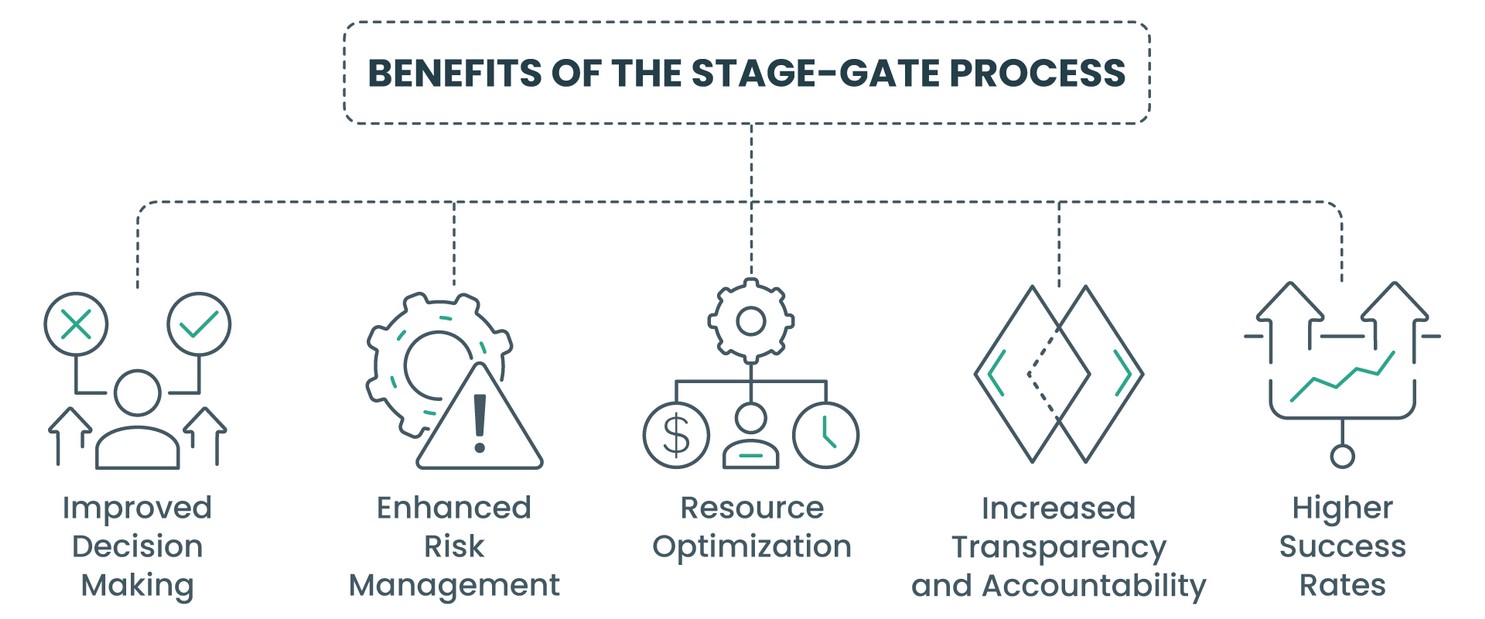
- Better decisions: clear criteria at each gate make go/kill decisions more objective and consistent.
- Lower risk: the biggest uncertainties are tested early, when it is still cheap to stop.
- Focused resources: weak projects are stopped, so money and people go to the most promising ones.
- Transparency: management sees where every project stands and what has been decided.
- Cross-functional alignment: marketing, R&D, operations and finance work from the same plan and the same definition of done for each stage.
Where the Stage-Gate process is used
| Industry | Typical use |
|---|---|
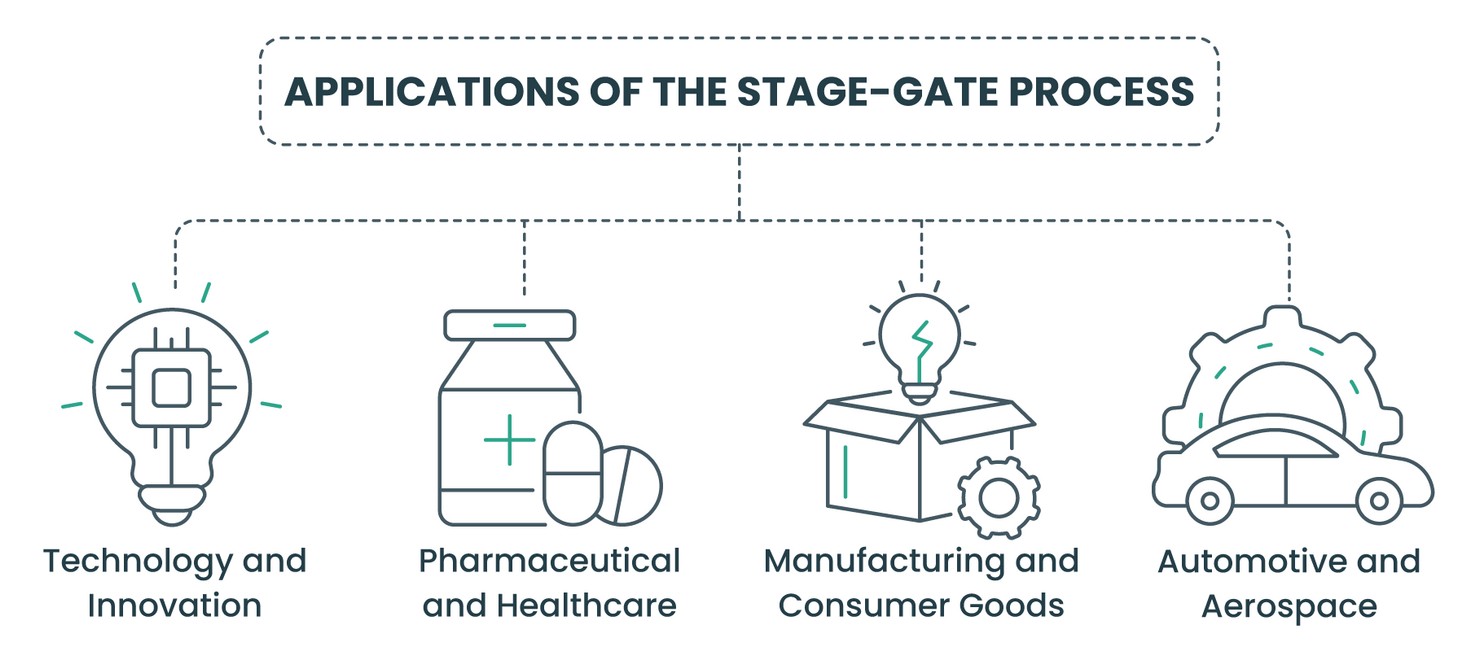
| Manufacturing and industrial machinery | New products, product variants and capital projects |
| Consumer goods and food | Product innovation from idea to shelf, often with many small projects |
| Pharma and healthcare | Development programs with regulatory checkpoints |
| Automotive and aerospace | Complex engineering programs with strict quality and safety reviews |
| Technology and IT | Product development and larger technology investments |
For the wider context of product development, see our guide to navigating new product development and our manufacturing project management guide.
Roles and responsibilities in the Stage-Gate process
| Role | Responsibilities |
|---|---|
| Gatekeepers | Senior managers who review projects at gates, apply the criteria, decide go/kill/hold/recycle and commit resources |
| Process owner | Designs and maintains the Stage-Gate process, templates and criteria; often sits in a PMO or innovation office |
| Project leader | Leads the cross-functional team through each stage and prepares gate deliverables |
| Cross-functional team | Members from R&D, marketing, operations, finance, quality and others who do the work in each stage |
| Sponsor or champion | Senior advocate who supports the project and helps secure resources |
| Subject matter experts | Provide specialist input, for example on regulation, technology or markets |
For more on team roles, see project team roles and responsibilities.
Stage-Gate and other project management methodologies
Stage-Gate is a governance framework: it defines when and how decisions are made. It does not prescribe how the work inside a stage is done, which is why it combines with other methods.
- Waterfall and PMI-style project management: Stage-Gate provides the investment decisions; project management methods plan and control the work within each stage. Our comparison of Stage-Gate and PMI project management explains the differences in detail.
- Agile: many organizations run development and testing stages in sprints, with customer feedback after each iteration, while keeping gates for major investment decisions. This hybrid is often called Agile-Stage-Gate.
- Lean: gates help eliminate waste by stopping projects that no longer create value, and lean thinking helps keep gate deliverables to what decision-makers actually need.

How to implement the Stage-Gate process
Introducing Stage-Gate is a change project in its own right. The main steps:
- Set up governance: name gatekeepers and a process owner, and define decision rights.
- Design stages and gates: decide on the number of stages for different project types and the deliverables for each gate.
- Define gate criteria: agree must-meet and should-meet criteria and a scoring approach.
- Provide templates and tools: business case, gate review and plan templates, and a system to track projects and decisions.
- Train teams and gatekeepers: explain the why, not just the forms.
- Pilot, then scale: start with a few projects, learn and adjust, then roll out more widely.
Our step-by-step guide on how to implement the Stage-Gate process covers each step in detail. You can also start from our free Stage-Gate template, read how to use a Stage-Gate process template, or map your process first with a Stage-Gate process map. Because the people side matters as much as the process, combine the rollout with structured change management.
Best practices and common mistakes
| Best practice | Common mistake it prevents |
|---|---|
| Make gates real decisions, with authority to kill projects | Gates that only review status, so nothing is ever stopped |
| Use clear, consistent criteria for every project | Decisions based on who presents best or shouts loudest |
| Do thorough homework before development | Moving into expensive development with an untested business case |
| Scale the process to project size and risk | One heavy process for every project, which teams then bypass |
| Check resource capacity at every go decision | Approving more projects than the organization can staff |
| Keep gate deliverables lean | Long documents that nobody reads before the meeting |
For a deeper look, see mastering Stage-Gate: best practices and common mistakes.
How to measure Stage-Gate success
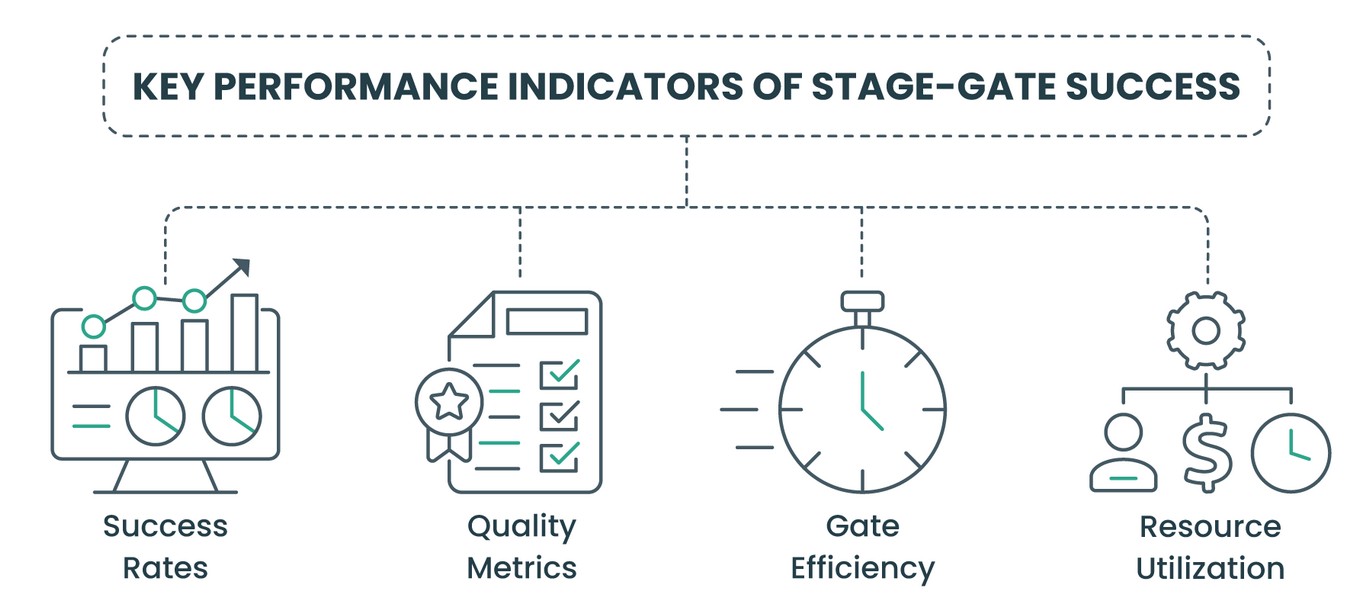
Measure both the projects and the process itself. Useful key performance indicators:
- Outcome: success rate of launched products against their business case, revenue from new products, return on R&D investment.
- Speed: time to market, time spent in each stage, time from gate submission to decision.
- Decision quality: share of projects killed at early gates versus late gates, number of projects recycled.
- Portfolio health: number of active projects against available capacity, balance across project types and risk levels.
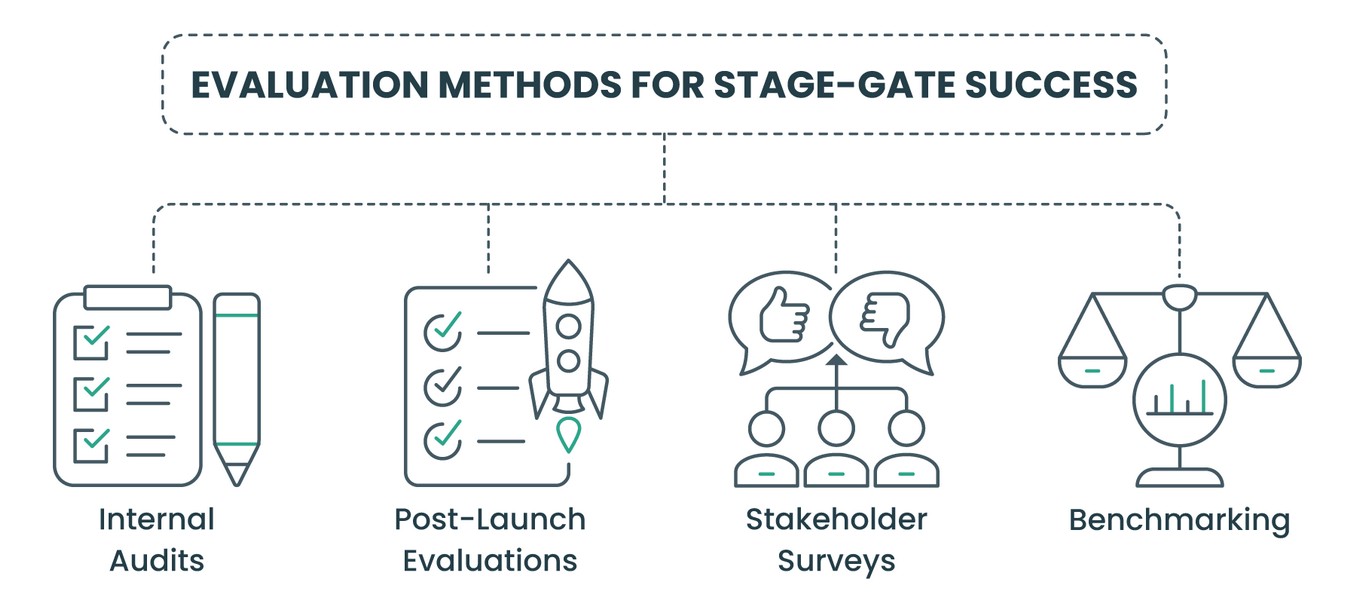
Review these indicators regularly, run post-launch reviews, and adjust stages, criteria and templates based on what you learn.
Stage-Gate across a project portfolio
A gate decision is never only about one project. Every go decision commits people and budget that other projects could have used. That is why mature organizations connect their Stage-Gate process to project portfolio management:
- Gates as portfolio decisions: gatekeepers compare a project not only with its own criteria but with the other projects competing for the same resources.
- Capacity checks: before a go, the resource demand of the next stage is checked against what teams can actually deliver, so that approved projects can be staffed.
- Portfolio reviews: in addition to individual gates, periodic reviews look at the whole pipeline: balance across product lines and risk levels, alignment with strategy, and projects to accelerate, hold or stop.
- One source of truth: stage, gate decisions, budgets and risks are visible in the same place for every project, so steering committees compare like with like. See portfolio governance in our glossary.
How software supports the Stage-Gate process

Spreadsheets and slide decks work for a handful of projects. As the pipeline grows, organizations typically move to dedicated software to enforce the process consistently: standard stages and gate deliverables per project type, approval workflows for gate decisions, a record of every decision, and portfolio dashboards that show where each project stands. For what to look for when choosing a tool, see our Stage-Gate software guide.
Cerri Project, for example, combines configurable phases with gate approvals, project templates, Gantt charts with cross-project dependencies, consolidated capacity views, budget tracking and portfolio dashboards, so that gate decisions are made with an up-to-date view of the project and of the shared resources it needs.
Stage-Gate process checklist
- Stages and gates are defined for each type of project, scaled to size and risk
- Each gate has defined deliverables, must-meet and should-meet criteria
- Gatekeepers are named and have the authority to commit resources
- Gate decisions (go, kill, hold, recycle) are recorded with their reasons
- Business cases are updated at each gate, not only at the start
- Resource capacity is checked before every go decision
- Templates exist for business cases, gate reviews and stage plans
- Project teams and gatekeepers are trained on the process
- Post-launch reviews compare results with the business case
- Process KPIs are reviewed and the process is improved regularly
Frequently asked questions
What is the Stage-Gate process?
The Stage-Gate process is a project governance framework that divides a project into stages separated by gates. At each gate, senior decision-makers review the results against defined criteria and decide whether the project should continue (go), stop (kill), pause (hold) or rework the current stage (recycle). It is most widely used for new product development.
What are the stages of the Stage-Gate process?
The classic model has a discovery stage followed by five stages: scoping, business case, development, testing and validation, and launch. Five gates separate them: idea screen, second screen, go to development, go to testing and go to launch. Many organizations use fewer stages for smaller projects.
What happens at a gate review?
At a gate review, the project team presents the agreed deliverables for that gate. The gatekeepers assess the project against must-meet and should-meet criteria, compare it with other projects competing for resources, and decide go, kill, hold or recycle. If the project continues, they approve the plan and resources for the next stage.
Who developed the Stage-Gate process?
Dr. Robert G. Cooper developed the Stage-Gate process in the 1980s, based on research into why some new products succeed and others fail. Stage-Gate is a registered trademark of Stage-Gate Inc.
What is the difference between Stage-Gate and phase-gate?
In everyday use the terms describe the same idea: a project divided into phases or stages, with a decision point at the end of each. Stage-Gate refers specifically to Robert Cooper's model for product development; phase-gate is the generic term used for the same approach in many industries.
Can Stage-Gate be combined with Agile?
Yes. Many organizations run the development and testing stages in short Agile iterations with frequent customer feedback, while keeping gates for the major investment decisions. This hybrid, often called Agile-Stage-Gate, combines the speed and flexibility of Agile with the governance of gates.
What are common challenges in Stage-Gate implementation?
Common challenges are gates that never kill projects, unclear or inconsistent criteria, too much bureaucracy for small projects, approving more projects than the organization can staff, and resistance from teams who see the process as paperwork. Clear criteria, a scaled process, capacity checks and good change management address most of them.
How does software support the Stage-Gate process?
Stage-Gate software standardizes stages and gate deliverables, routes gate approvals, records decisions, and gives management a portfolio view of all projects, their stage, budget and resource needs. This makes the process easier to follow and harder to bypass as the number of projects grows.
Stage-Gate® is a registered trademark of Stage-Gate Inc.
How useful was this article?
Get enterprise PM insights, no noise
A bi-monthly briefing on Stage-Gate governance, portfolio management, and enterprise delivery best practices.
No spam. Unsubscribe anytime.
Prefer video? Watch on YouTube
Walkthroughs, Stage-Gate demos, and manufacturing PM best practices on our channel.