How regulated industries can embed compliance into project governance rather than treating it as a separate overhead.
1. Introduction
In industries such as finance, pharmaceuticals, and the public sector, project success depends on more than schedules and budgets. Projects must also comply with strict regulatory requirements. This is where compliance in project management becomes essential. Every initiative needs to be planned and executed with legal standards, data protection rules, and audit readiness built in.
Unlike less regulated sectors, even small oversights can cause financial losses, legal penalties, or reputational harm. In compliance-driven industries, project management is not only about efficiency. It also requires strong governance and accountability at every stage.
As the Project Management Institute notes, "Compliance is not a barrier to project management - it is a framework for ensuring projects deliver sustainable value." ¹
In this article, we explore the challenges of managing projects under strict regulations. We will outline proven best practices to reduce risk, and we will show how project portfolio management (PPM) software supports compliance without slowing progress.
2. Compliance challenges in project management
Projects in regulated industries face additional hurdles compared to those in less restricted environments. Compliance in project management introduces layers of responsibility that go beyond the typical concerns of scope, schedule, and budget. These challenges are common across finance, pharmaceuticals, and the public sector, even if the regulations differ.
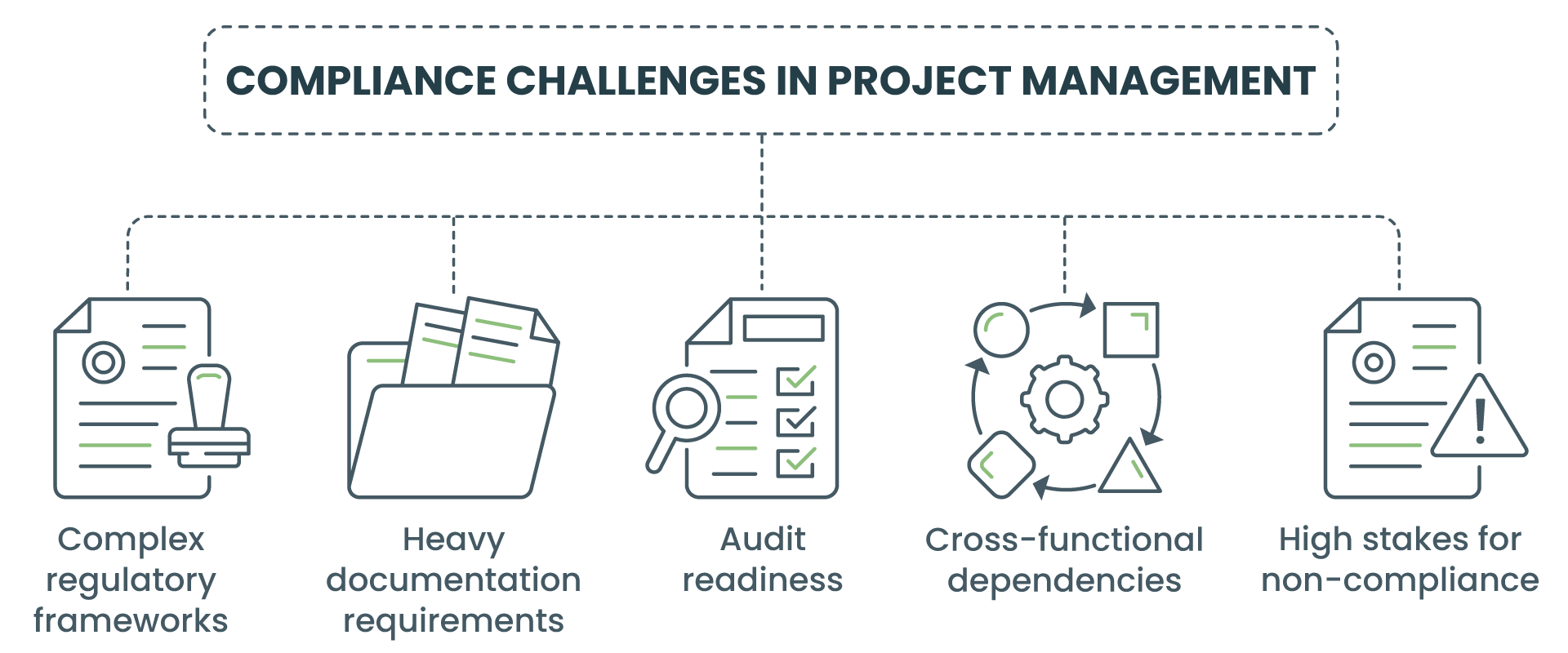
Complex regulatory frameworks
Projects must align with detailed laws and standards that often change over time. Staying up to date requires continuous monitoring and adaptation.
Heavy documentation requirements
Regulators demand clear, consistent, and traceable records. Maintaining this level of documentation adds administrative weight to projects.
Audit readiness
Projects in regulated environments must always be prepared for external inspections. This means approvals, records, and workflows must be accurate and up to date at all times.
Cross-functional dependencies
Compliance is not the responsibility of project managers alone. It requires collaboration with legal, IT, operations, and external stakeholders, which can create delays if not well coordinated.
High stakes for non-compliance
Failure to meet requirements can trigger financial penalties, reputational damage, or even legal action. In some industries, such as healthcare or finance, non-compliance can also put lives or livelihoods at risk.
These challenges show why compliance cannot be treated as an afterthought. Instead, it must be embedded into the very structure of project management.
3. Best practices for managing projects in compliance-heavy contexts
To succeed in highly regulated environments, organizations must embed compliance in project management rather than treat it as an afterthought. The following practices help project teams balance regulatory obligations with efficiency:
1. Integrate compliance into workflows Compliance tasks should be built directly into project plans. When regulatory milestones align with project deliverables, teams reduce the risk of missing critical requirements.
2. Standardize documentation and reporting Consistent templates and centralized repositories make records easier to access and verify. This ensures stakeholders always work from the same source of truth and remain ready for audits.
3. Establish clear governance frameworks Defined processes, roles, and responsibilities strengthen accountability. Frameworks such as PRINCE2 or PMI standards can be adapted to ensure compliance oversight is structured and transparent.
4. Promote cross-functional collaboration Compliance officers, legal experts, and operations teams should work alongside project managers from the start. Early involvement avoids costly delays caused by late-stage reviews or missed approvals.
5. Maintain audit readiness continuously Records, approvals, and documentation should be updated throughout the project. Preparing for audits as an ongoing process prevents last-minute gaps or rushed compliance checks.
4. Role of technology and PPM software in compliance-driven project management
Technology can transform compliance from a bottleneck into a built-in strength. Modern project portfolio management (PPM) tools give organizations the visibility and control needed to operate in regulated environments.
Centralized data and documentation
Secure, centralized repositories ensure that financial reports, clinical trial data, and public sector approvals are accessible, version-controlled, and always audit-ready.
Traceability and audit trails
Digital platforms record approvals, changes, and communications automatically. This creates a transparent history of project activity, essential for regulators and internal governance.
Cerri Project supports compliance-driven organizations with secure document management, traceable workflows, and customizable reporting features. These tools help teams in finance, pharmaceuticals, and the public sector meet strict compliance demands while maintaining efficiency and accountability.
5. Case examples and sector-specific considerations
The principles of compliance in project management apply across all regulated industries, but each sector has its own priorities and risks.

Finance
Strong data integrity, real-time monitoring, and strict access controls are essential. Financial institutions must ensure that every transaction-related project complies with regulations such as Basel III, MiFID II, and anti-money laundering (AML) requirements. Errors in compliance can result in heavy fines and loss of trust.

Pharmaceuticals
Documentation must satisfy FDA and EMA standards, with frequent and detailed audits throughout the product lifecycle. Clinical trials, regulatory submissions, and quality management all depend on traceable, validated processes. Delays in compliance can slow time-to-market for critical treatments.

Public sector
Every step is subject to procurement rules, cost justification, and public oversight. Government projects must balance accountability with efficiency, ensuring taxpayer funds are used responsibly. Transparency and audit readiness are not optional - they are foundational expectations.
6. Future trends in compliance-driven project management
Regulations continue to evolve, and oversight grows stronger each year. To keep pace, organizations must adapt how they approach compliance in project management. Several key trends are already shaping the future:

- AI-driven compliance monitoring - Artificial intelligence can flag potential risks, detect anomalies, and automate repetitive checks. This reduces manual effort and allows teams to focus on higher-value tasks.
- Cloud platforms with certifications - Regulated industries increasingly rely on cloud-based PPM solutions certified under ISO 27001, SOC 2, or GDPR standards. These certifications reassure regulators while still enabling global collaboration.
- Real-time reporting and transparency - Regulators demand more frequent updates. Real-time dashboards and reporting tools help organizations share accurate compliance data instantly, building accountability and reducing delays.
- Integrated governance frameworks - Compliance tasks such as approvals, risk reviews, and validations are being built directly into project workflows. This ensures critical steps cannot be bypassed.
- Cross-sector collaboration - With public–private partnerships and global supply chains becoming common, organizations need flexible systems that address diverse compliance requirements across multiple industries.
As Deloitte highlights, "Compliance is moving from being a reactive obligation to becoming a proactive enabler of trust and resilience." ³
These trends show that compliance is no longer just a regulatory hurdle. It is becoming a driver of innovation, accountability, and long-term trust in project delivery.
7. Conclusion
For organizations in finance, pharmaceuticals, and the public sector, compliance in project management is more than a requirement - it is the foundation of sustainable operations. Projects succeed only when they meet strict legal, regulatory, and ethical standards while still delivering value on time and within budget.
By embedding compliance into planning, execution, and reporting, organizations reduce risk, strengthen audit readiness, and build trust with stakeholders. Project portfolio management (PPM) software plays a key role in this process. It centralizes records, standardizes workflows, and ensures transparency across all phases of the project lifecycle.
Cerri Project, for example, supports compliance-driven industries with secure documentation, traceable workflows, and customizable reporting. These features allow teams to meet regulatory demands without sacrificing efficiency or performance.
In an era of increasing oversight, aligning compliance with project management is more than a safeguard. It is also a strategic advantage that helps organizations stay resilient, competitive, and trusted in the eyes of regulators and stakeholders alike.
Sources and references
¹ Project Management Institute (PMI) - Pulse of the Profession®: Next Practices in Project Governance
² McKinsey & Company - Improving compliance in regulated industries
³ Deloitte - Compliance in a digital world
How useful was this article?
Get enterprise PM insights, no noise
A bi-monthly briefing on Stage-Gate governance, portfolio management, and enterprise delivery best practices.
No spam. Unsubscribe anytime.
Prefer video? Watch on YouTube
Walkthroughs, Stage-Gate demos, and manufacturing PM best practices on our channel.