Workload management and resource allocation are both essential parts of resource management in project management - but they solve different problems at different stages of project delivery. This article explains what each discipline does, where they fit, and how they work together.
Workload management and resource allocation are both essential parts of resource management in project management - but they solve different problems at different stages of project delivery.
Resource allocation determines which resources are assigned to which projects. It happens during planning, before work begins. Workload management determines how tasks are distributed across individuals once those resources are in place. It operates during execution.
Confusing the two leads to inefficient planning. Teams try to fix workload imbalances when the real problem is poor allocation - or they assign people across projects without realizing those individuals are already overloaded. Understanding where each practice fits is essential for managing project resources effectively.
In this article, we explain what each discipline does, where they fit in project management, and how they work together.
For a broader overview of these practices, see our guide to resource management in project management.

What is workload management?
Workload management is a core discipline in project management, focused on how work is distributed across individuals or teams during project execution.
Once a project begins, tasks must be assigned in a way that keeps work moving while avoiding overload. Workload management helps project managers see who is responsible for what and whether assignments remain realistic.
Typical workload management activities include:
- balancing tasks across team members
- identifying overloaded individuals
- redistributing assignments when priorities change
- monitoring short-term work distribution
In practice, workload management operates mainly at the execution level. The work already exists, and the goal is to distribute it effectively.
Without clear workload visibility, teams often appear busy while progress slows. A single overloaded specialist can quickly become a bottleneck that delays multiple tasks or milestones.
As a result, many organizations introduce workload views or dashboards that help project managers detect imbalances early and rebalance assignments before delays occur.

What is resource allocation?
Resource allocation takes place earlier in the planning process. Instead of focusing on daily task distribution, it determines which resources are assigned to which projects or initiatives.
Most organizations run several initiatives at the same time. Each project requires specific skills, roles, and levels of effort. Resource allocation helps leaders decide how those resources should be distributed.
Typical resource allocation decisions include:
- which teams support which projects
- how much effort each initiative receives
- which skills are required during different phases
- when resources move between initiatives
Resource allocation therefore defines where resources are committed across the project portfolio.
Once those resources are assigned to a project, workload management then distributes the work inside those assignments.
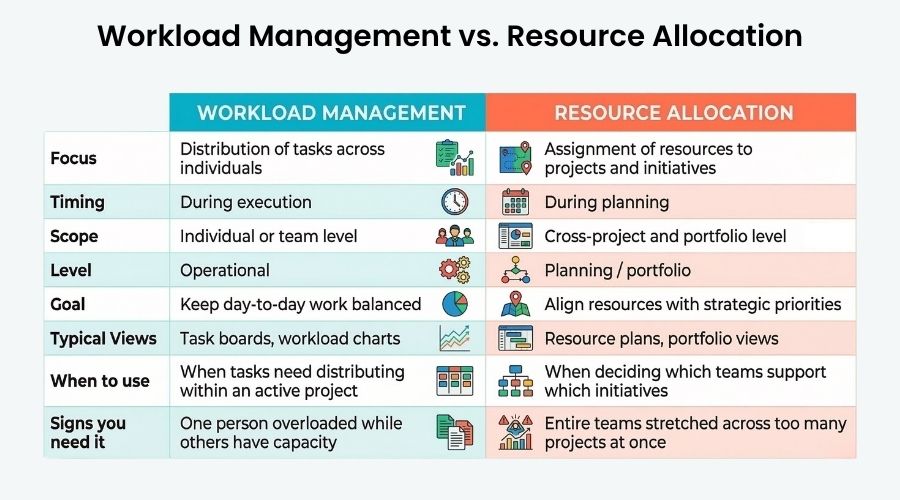
Workload management vs resource allocation
Although both practices belong to resource management, they operate at different levels of planning and control.
In simple terms
Resource allocation decides who works on which projects.
Workload management decides how work is distributed once those assignments exist.
Both are essential. Without proper allocation, projects compete for the same specialists. Without workload management, individuals become overloaded even when allocations appear reasonable on paper.

Why organizations often confuse the two
Despite their differences, organizations frequently treat workload management and resource allocation as the same activity. Several factors contribute to this confusion.
Tools designed for tasks rather than resources
Many project tools focus on task tracking. They show what work needs to be done but provide limited visibility into how resources are shared across projects. As a result, project managers optimize task completion without ever seeing the allocation picture that sits above it.
Fragmented planning processes
Portfolio planning, project planning, and execution often occur in separate systems. When these layers are disconnected, allocation decisions and workload balancing become difficult to distinguish. Teams end up making resourcing decisions at the wrong level - adjusting workloads when the real fix requires reallocating resources between initiatives entirely.
Limited cross-project visibility
Project managers often see only their own projects. Without a portfolio view of resources, conflicts between initiatives remain hidden until they surface as delays. By that point, the problem has usually been misdiagnosed as a workload issue when the root cause is an allocation decision made weeks earlier.
Spreadsheet-driven planning
Spreadsheets are flexible but difficult to maintain as projects multiply. Over time, resource data becomes outdated or inconsistent, and the distinction between who is allocated to a project and how much work they are actually carrying becomes impossible to track reliably.
Reactive rather than proactive planning cultures
In organizations where resource decisions are made in response to problems rather than in advance, the line between allocation and workload management collapses. Everything becomes an immediate execution problem, and the planning layer - where allocation decisions belong - never gets the attention it requires.
Role ambiguity between project managers and resource managers
In many organizations, no one owns allocation explicitly. Project managers manage workloads within their projects, but no one has visibility across projects. This gap means allocation happens informally - through whoever shouts loudest for resources - rather than through a structured planning process.
Together, these factors make it genuinely difficult to identify whether a problem stems from poor allocation or from uneven workloads - and harder still to know where to start fixing it.

How workload management and resource allocation work together
Effective resource management usually follows a structured sequence.
1. Resource allocation
Leadership decides how resources are distributed across projects. At this stage, organizations determine which initiatives receive priority and which teams support them.
2. Workload management
Once resources are assigned to projects, project managers distribute tasks across individuals to keep work balanced.
3. Continuous adjustment
Projects rarely remain static. Priorities shift, specialists become unavailable, and new initiatives appear. Both allocation and workload must therefore evolve over time.
Organizations that maintain visibility across these layers adjust plans early rather than reacting to overload once delays occur.
4. In practice
Example: A software company is running three initiatives simultaneously - a product launch, a platform migration, and a client onboarding project. Leadership uses resource allocation to decide that two senior engineers and one QA specialist will support the product launch for the next quarter, with the remaining engineering capacity split across the other two initiatives.
Once those assignments are confirmed, the project manager uses workload management to distribute sprint tasks across the two engineers. One engineer is finishing a carry-over task from the previous sprint, so the project manager redistributes two upcoming tasks to the other to keep the workload balanced and the milestone on track.
This is the distinction in practice. Allocation decided who was on the project. Workload management decided how the work moved between them week to week.
This is especially relevant for teams managing resources across multiple projects, where the stakes of poor allocation or uneven workloads are compounded across every initiative simultaneously.

Why visibility matters for resource management
Both workload management and resource allocation depend on accurate project data.
When information about assignments, timelines, and availability is scattered across tools or spreadsheets, teams lose the ability to detect resource conflicts early. Decisions then rely on assumptions rather than reliable information.
Over time, this lack of visibility produces familiar symptoms:
- overloaded specialists
- delayed milestones
- competing priorities across projects
- constant re-planning during execution
Improving visibility helps organizations identify these conflicts earlier and rebalance work before delivery suffers.

The role of resource management tools
As organizations handle more initiatives simultaneously, manual resource planning becomes difficult to maintain.
Resource management software helps by providing:
- cross-project views of resource assignments
- workload visualization that highlights overload or availability
- planning tools for allocating resources across initiatives
- early detection of resource conflicts
By combining allocation planning and workload monitoring in a single environment, organizations gain better control over how work is distributed.
Purpose-built resource management software helps organizations maintain this visibility across complex project portfolios.
Conclusion
Workload management and resource allocation are not interchangeable - and treating them as the same practice is one of the most common reasons resource management breaks down in otherwise well-run organizations.
Allocation sets the foundation. It determines which projects receive resources and at what level of commitment. Workload management builds on that foundation. It keeps individuals productive and prevents the overload that turns reasonable plans into missed deadlines.
When both practices are visible, connected, and actively managed, organizations stop reacting to resource problems and start anticipating them. That shift - from reactive to proactive - is where the real efficiency gains in project delivery come from.
To understand how these practices fit into the broader discipline, read our complete guide to resource management in project management.
Frequently asked questions
What is the difference between workload management and resource allocation?
Resource allocation determines which resources are assigned to which projects, and happens during the planning phase. Workload management determines how tasks are distributed across individuals within those assignments, and operates during execution. Allocation works at the portfolio level; workload management works at the individual or team level.
Is workload management part of resource management?
Yes. Workload management is one component of broader resource management. While resource allocation determines which people or teams support each project, workload management ensures that tasks are distributed realistically among those individuals during execution.
Which comes first - resource allocation or workload management?
Resource allocation always comes first. Leaders decide which teams and individuals are committed to which initiatives before work begins. Once those assignments exist, project managers use workload management to distribute tasks and keep day-to-day work balanced.
What are the signs of a workload problem versus an allocation problem?
A workload problem typically shows up as one or two overloaded individuals within a project, while others have capacity. An allocation problem shows up as an entire team stretched across too many initiatives simultaneously, with no single project receiving enough resource to progress effectively. Both produce delays, but they require different fixes.
Can workload management and resource allocation be managed in the same tool?
Yes. Purpose-built resource management software typically combines both functions - providing portfolio-level allocation views alongside individual workload charts. Managing both in a single environment significantly improves visibility and reduces the risk of conflicts going undetected.
How useful was this article?
Get enterprise PM insights, no noise
A bi-monthly briefing on Stage-Gate governance, portfolio management, and enterprise delivery best practices.
No spam. Unsubscribe anytime.
Prefer video? Watch on YouTube
Walkthroughs, Stage-Gate demos, and manufacturing PM best practices on our channel.