Capacity vs workload management is one of the most misunderstood distinctions in project management. Capacity asks can we take this on? Workload asks who does the work? Confusing the two is one of the most common reasons portfolios become overloaded and deadlines slip without a single clear cause.
Capacity vs workload management is one of the most misunderstood distinctions in project management. Capacity management asks *can we take this on?* Workload management asks *who does the work?* Both deal with the same ingredients - people, time, and projects - but they operate at entirely different stages of the delivery process. Confusing the two is one of the most common reasons portfolios become overloaded and deadlines slip without a single clear cause.
Most organizations recognize the symptoms. Projects are approved, tasks are assigned, and teams stay busy. Then friction builds. Deadlines slip. Priorities collide. The same people are needed in multiple places at once.
The instinct is to turn to workload management to fix the problem. But by then, it is already too late - because the overcommitment happened upstream, before workload management had any role to play.
This article explains why that distinction matters for delivery and how the two practices work together in a functioning planning system.

What is capacity management in project management?
Capacity management in project management sits at the very beginning of the decision process. It focuses on limits rather than activity and helps organizations understand how much work they can realistically take on without putting delivery at risk.
At its core, it answers one question: How much work can we take on - without breaking delivery?
To answer this, organizations need a clear view of their constraints. These typically include:
- available people and critical skills
- timing and sequencing across projects
- competing initiatives drawing on the same resources
- financial or operational limits
Capacity is not about how busy teams look. It is about whether they can absorb additional work without increasing risk.
As explained in our capacity management guide, teams may appear fully engaged while still lacking the capacity to take on more work safely.
That distinction matters.
Because when capacity is treated as an assumption instead of a constraint, planning becomes optimistic - and execution pays the price.

What is workload management?
Workload management operates later in the process, once work is already underway. It focuses on execution and helps teams manage how tasks are distributed across individuals and roles.
Instead of asking what is feasible, workload management deals with what has already been committed.
In practical terms, it focuses on:
- how work is distributed across people and teams
- where short-term overload appears
- how tasks can be reassigned or adjusted
- how delivery can stay on track day to day
This makes workload management essential for maintaining balance during execution. It allows teams to respond to pressure, adjust assignments, and keep work moving as conditions change.
However, it operates within a fixed context. The work has already been approved, expectations are already set, and dependencies are already in motion. Because of this, workload management can improve how work is handled - but it cannot reduce the amount of work itself.
This is where the distinction becomes important.
Workload management helps teams cope with pressure. Capacity management determines whether that pressure should exist in the first place.

Capacity vs workload management: the core difference
Whether you frame it as capacity vs workload management or workload vs capacity planning, the real distinction is not about terminology - it is about timing and control.
Both deal with the same elements - people, time, and work - and are often grouped under resource management. However, they operate at different stages of the planning and delivery process. Understanding this distinction is what allows organizations to move from reactive execution to controlled delivery.
The simplest way to see the difference is side by side:
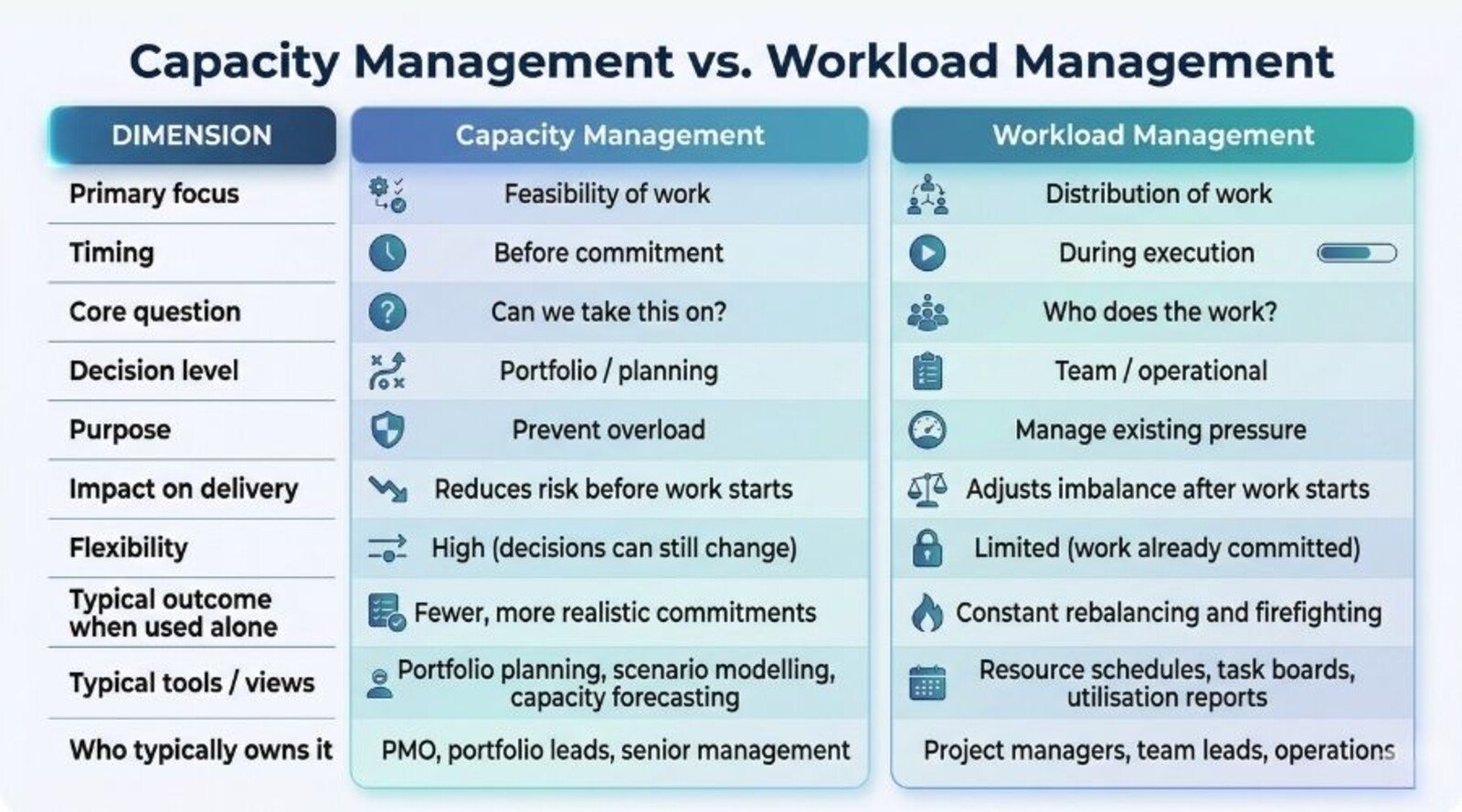
This distinction explains why many organizations feel in control at the planning stage but struggle during execution. When capacity is not considered early, too much work is approved. Workload management then becomes the only mechanism available to manage the consequences.
The result is a system that reacts instead of one that decides.
In practice, both are necessary - but they are not interchangeable. Capacity management determines what should move forward, while workload management ensures that execution remains balanced once it does.

Why this confusion causes delivery problems
It starts with overcommitment
When organizations confuse capacity management vs workload management, the issue begins at the planning stage.
Projects are approved based on priority, urgency, or stakeholder pressure - but not on a clear understanding of available capacity. At that point, everything still appears manageable because the impact of those decisions has not yet surfaced.
The problem is not visible yet - but it is already in motion.
Consider a software delivery team managing five concurrent projects. Each initiative looks feasible in isolation - the right skills exist, the timelines seem reasonable, and stakeholders have signed off. But no one has asked whether the same three senior engineers can realistically carry critical roles across all five at once. Capacity was never treated as a constraint. It was treated as an assumption. Six weeks in, every project is moving, but none is moving well. That is not an execution problem. It is a planning problem that workload management cannot fix.
The pressure shows up during execution
As projects progress, constraints begin to collide. The same people are required across multiple initiatives, dependencies become harder to manage, and progress slows down across the board.
At this stage, organizations turn to workload management to rebalance tasks and keep delivery moving. While this helps in the short term, it does not address the root issue.
Instead, it shifts the burden to execution.
The same pattern repeats
Without capacity-driven decisions upfront, teams typically experience the same set of issues:
- too many projects running in parallel without realistic limits
- critical resources stretched across competing priorities
- slower progress due to resource contention
- constant reprioritization instead of steady execution
- gradual deadline slippage without a single clear failure point
Each issue on its own seems manageable. Together, they create a system that operates under continuous pressure. This is one of the most common causes of project overcommitment.
The root cause is misplaced responsibility
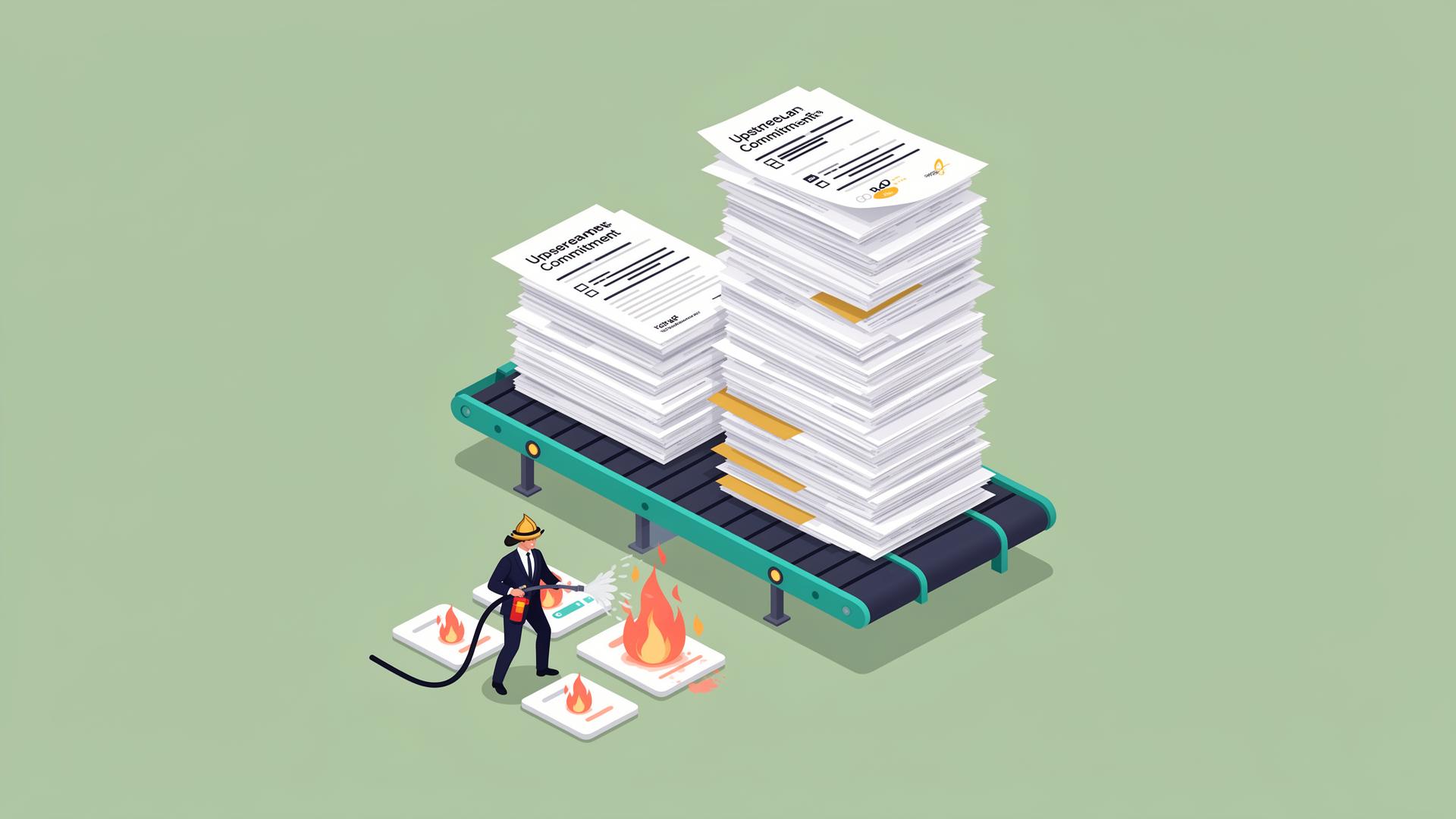
Over time, this confusion leads organizations to rely on workload management to fix structural problems. But workload management can only redistribute effort - it cannot reduce the volume of work that has already been committed.
That responsibility sits with capacity management.
When capacity is not considered early, execution becomes reactive. And when execution becomes reactive, predictability disappears.
Why workload management alone is not enough
Most organizations do not ignore capacity management intentionally. They simply rely too heavily on workload management because it is more visible, more immediate, and easier to act on.
It feels productive.
Teams can see overloaded individuals, rebalance assignments, and make short-term adjustments. From the outside, it looks like control.
But this creates a false sense of stability.
Why does workload management alone fail to prevent delivery problems?
Workload management operates after decisions have already been made. By the time teams start redistributing tasks, the volume of work is fixed.
This leads to a situation where teams are constantly adjusting - but never truly stabilizing.
The system keeps moving, but it does not improve.
What organizations experience over time
When workload management becomes the primary control mechanism, the same symptoms tend to appear:
- teams remain busy, but progress feels slower than expected
- priorities shift frequently, even without major external changes
- key individuals become ongoing bottlenecks
- delivery timelines stretch without clear root causes
- planning cycles lose credibility over time
These are not execution failures. They are signals that too much work was committed upstream.
What is missing from a workload-only approach?
What is missing is not better task distribution - it is better decision-making before work begins.
Capacity management introduces that layer. It forces organizations to evaluate trade-offs, limit commitments, and align demand with what can realistically be delivered.
Without it, workload management becomes a continuous balancing act.
With it, workload management becomes far more effective - because it operates within realistic limits.
How capacity and workload management work together
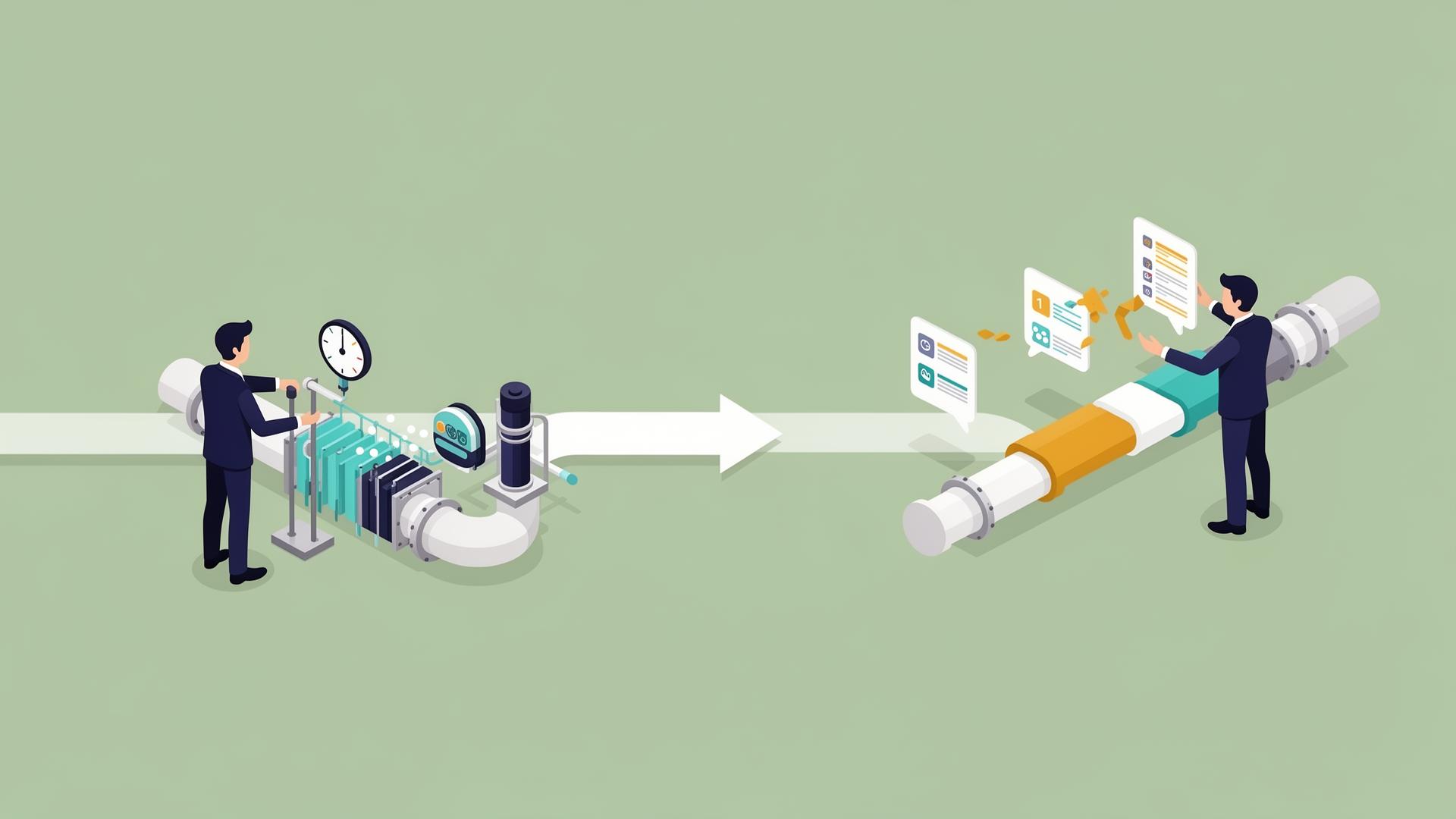
Managing capacity vs workload is not a choice between competing approaches. They operate at different stages of the same system and are most effective when used together.
One defines what should happen. The other ensures it happens in a controlled way.
Capacity sets the direction
Capacity management sits upstream, at the point where decisions are still flexible. It helps organizations evaluate demand against real constraints before committing to new work.
At this stage, the focus is not on assigning tasks but on making informed choices. Which projects can realistically move forward? Which should be delayed, reduced, or declined?
This is where trade-offs happen.
By aligning demand with available capacity, organizations avoid overloading teams before execution even begins. Fewer initiatives are approved - but those that are have a far higher chance of being delivered successfully.
Workload keeps execution balanced
Once work is approved, workload management takes over. Its role is to distribute tasks, monitor pressure points, and maintain balance across teams.
This includes:
- assigning work based on availability and skills
- identifying short-term overload
- adjusting tasks as priorities evolve
- keeping delivery moving despite day-to-day variability
At this stage, the objective is not to question the work itself, but to ensure it progresses efficiently.
The hand-off is where most organizations fail
The transition between capacity planning and workload management is often where problems emerge.
If too much work is approved upstream, workload management inherits an impossible situation. Teams can redistribute effort, but they cannot reduce the underlying demand. This leads to constant adjustments, competing priorities, and gradual delivery slowdowns.
When the hand-off is managed properly, the dynamic changes completely. Workload management operates within realistic limits, and execution becomes far more stable.
How do capacity and workload management work together in practice?
Capacity management decides what should start. Workload management ensures it runs smoothly.
Used together, they create a system that is both selective and controlled - one that prevents overload instead of reacting to it.
Conclusion
The difference between capacity vs workload management - or capacity planning vs workload management as it is often framed - is not just a matter of terminology. It shapes how organizations plan, prioritize, and deliver work.
When capacity is ignored, too much is approved. Workload management is then left to absorb the pressure, leading to constant adjustments, slower progress, and reduced predictability.
When capacity is considered early, the dynamic changes. Fewer initiatives move forward, but they are grounded in what the organization can realistically deliver. Workload management becomes more effective because it operates within clear limits instead of reacting to overload.
The goal is not to choose between the two.
It is to use them at the right time, for the right purpose.
Capacity management defines what is possible. Workload management ensures it is delivered well. For a deeper look at how allocation fits between the two, see our resource management guide. Together, they create a system that replaces reactive execution with controlled, reliable delivery.
How useful was this article?
Get enterprise PM insights, no noise
A bi-monthly briefing on Stage-Gate governance, portfolio management, and enterprise delivery best practices.
No spam. Unsubscribe anytime.
Prefer video? Watch on YouTube
Walkthroughs, Stage-Gate demos, and manufacturing PM best practices on our channel.